A Legacy Worth More Than Property: How Surrey's Affluent Families Are Raising the Next Generation on the Principles of Self-Care
The Inheritance Nobody Talks About
In Surrey's leafier postcodes — from the well-appointed streets of Cobham to the expansive family homes of Weybridge and Virginia Water — conversations about legacy tend to orbit familiar themes: property portfolios, school placements, trust funds, and the careful stewardship of accumulated wealth. Yet a growing number of families in these circles are quietly expanding their definition of what is worth passing down.
Wellness, it turns out, is becoming one of the most considered gifts a parent can offer a child.
This is not simply a matter of booking a teenager's first facial or gifting a spa day on an eighteenth birthday. What is emerging across Surrey's affluent communities is something considerably more intentional — a structured, values-led approach to teaching the next generation how to inhabit their own bodies with care, attentiveness, and respect. The language of self-care, once dismissed as the vocabulary of indulgence, is being reclaimed as a framework for lifelong health literacy.
Why Wellness Families Are Thinking Generationally
For those who have spent decades building professional success, the physical and psychological cost of that journey rarely goes unacknowledged. Many high-achieving parents in Surrey have arrived at their forties and fifties with a hard-won understanding of what chronic stress, poor sleep, and neglected self-care actually cost — not in abstract terms, but in their skin, their posture, their mood, and their relationships.
It is precisely this experiential knowledge that is driving a different kind of conversation at home.
Rather than allowing the next generation to discover these lessons through their own exhaustion, many parents are choosing to introduce wellness principles early — not as luxury, but as literacy. The distinction matters. When self-care is framed as an occasional treat, it remains peripheral. When it is presented as a consistent practice embedded in daily and weekly routine, it becomes foundational.
Psychologists who work with young adults frequently note that attitudes toward rest, body awareness, and stress regulation are shaped profoundly during adolescence and early adulthood. Families who normalise therapeutic touch, skincare discipline, and intentional relaxation during these formative years are, in effect, building neurological and behavioural blueprints that persist well into adult life.
The Spa as Classroom
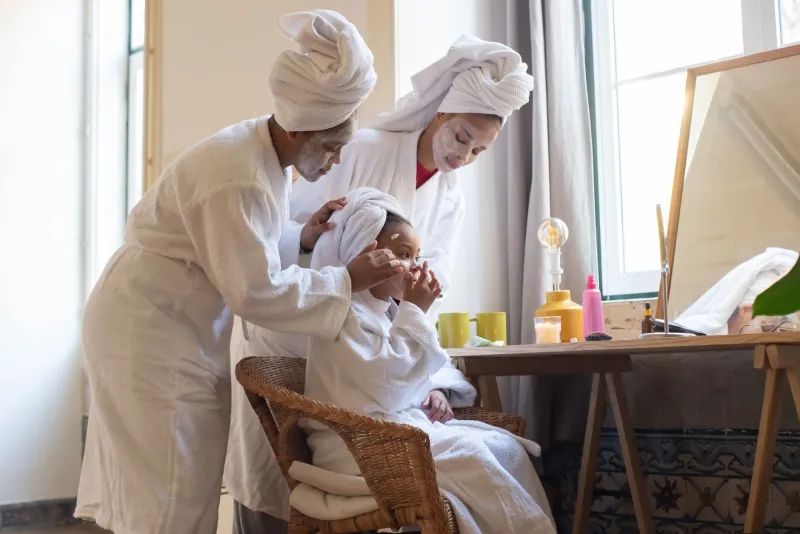
For many Surrey families, the spa environment serves as an unexpectedly powerful educational setting. It is a space in which young people are invited to slow down, to listen to their bodies, and to understand — often for the first time — what it feels like to be genuinely at ease.
This is not a trivial lesson. In a generation shaped by relentless digital stimulation, academic pressure, and an always-on social landscape, the capacity to be still is genuinely rare. Young adults who are introduced to spa wellness in a considered, age-appropriate way frequently describe the experience as revelatory — not because of the luxury itself, but because of the contrast it provides.
At Cornelia Spa at The Surrey, we regularly welcome guests who are visiting alongside family members, and the conversations that unfold in our tranquil spaces often carry a depth that surprises first-time visitors. Parents and their adult children speak of these shared experiences as moments of genuine connection — removed from the noise of daily life and the usual dynamics of home.
Skincare consultations, in particular, offer a practical entry point. Understanding one's skin type, learning which ingredients support rather than compromise the skin barrier, and appreciating the cumulative benefit of consistent treatment — these are lessons that a well-trained therapist can convey with far more authority than any online tutorial. For young women and men alike, this kind of knowledge becomes a form of self-possession.
Stress Literacy: Teaching the Body's Language
Perhaps the most significant dimension of this generational shift is the growing emphasis on what might be called stress literacy — the ability to recognise, name, and respond to the body's signals before they escalate into something more serious.
Surrey's professional culture is, by its nature, high-pressure. Many parents who have built careers in finance, law, medicine, or entrepreneurship carry the physical evidence of sustained stress — in their posture, their complexion, and their sleep patterns. The desire to spare their children from repeating those patterns is sincere and, increasingly, strategic.
Wellness-conscious families are introducing practices such as breathwork, guided relaxation, and regular massage not as indulgences but as skills. In the same way that a child might be taught to eat well or exercise regularly, they are being taught to decompress — to treat the nervous system with the same intentionality they might apply to any other aspect of their health.
This is a profoundly modern form of parenting, and one that reflects a broader cultural maturation in how British society understands mental and physical wellbeing. The stiff-upper-lip tradition of ignoring one's internal state is giving way, particularly among educated, affluent households, to a more emotionally intelligent model — one in which acknowledging the need for rest is not weakness but wisdom.
The Social Currency of Wellbeing
There is, of course, a social dimension to all of this. In Surrey's most established circles, the markers of success are quietly evolving. Where once the most visible signals of affluence were material — the car, the holiday, the wardrobe — there is a discernible shift toward what might be described as embodied wealth: the kind that is visible in a person's skin, their composure, their energy, and their presence.
Young adults raised within a wellness culture carry these qualities naturally. They tend to approach high-pressure environments with greater equanimity, to make more considered decisions about their time and energy, and to maintain the kind of physical appearance that reflects genuine health rather than simply grooming.
For parents who have worked hard to position their children advantageously in life, this is no small thing. The capacity to present oneself with calm authority — to walk into a room looking rested, grounded, and well — is a social and professional asset of considerable value.
An Investment That Compounds
At Cornelia Spa at The Surrey, we understand that the most meaningful wellness journeys are not those taken in a single afternoon, but those built across months and years of consistent, conscious practice. The families who visit us regularly — sometimes across two or even three generations — embody this understanding with quiet elegance.
What they are building together is not merely a shared habit, but a shared set of values: that the body deserves care, that rest is not laziness, that beauty and health are inseparable, and that the discipline of looking after oneself is one of the most generous things a person can model for those who follow.
In this sense, the spa is not simply a destination. It is a school — one without a prospectus, but with lessons that last a lifetime.


